Elite Commando: Gun Games
- 4.4
- Rating
- 10.00M
- Installs
- Free
- Price
 Analysis by App-foxy
Elite Commando: Gun Games puts me in the role of a soldier and gets straight to the point: missions, movement, and gunfights. It is a free action game from Bolt Bridge Games, aimed at players who want a military-flavored experience that can be picked up without a long explanation. After spending time with it, my strongest impression is that its appeal comes less from a complicated tactical system and more from the way it combines a direct objective structure with a steady combat mood.
The game has the kind of presentation that makes sense for short sessions. I can open it when I have a little time, complete a mission, and leave without feeling that I need to study a large menu of systems first. That accessibility is a real strength, especially for people who enjoy shooting games but do not want the commitment of a huge competitive title. At the same time, players looking for deep squad management, a broad story campaign, or highly technical multiplayer combat may find the experience more limited than the name suggests.
My overall recommendation is simple: this is worth trying if you want a free, focused action game with a soldier setting and a clear mission-driven rhythm. I would approach it as a compact mobile shooter rather than as a full console-style military simulation.
You May Also Like

 Blood Strike: 2.5 Anniversary
Blood Strike’s Loadouts Turn Every Drop Into a Tactical Gamble
A close look at Blood Strike’s custom loadouts: how fast access to signature weapons reshapes its battle royale rhythm, rewards preparation, and narrows the gap between fights.

 Pandora - Music & Podcasts
Pandora’s Music Is Easy to Start, but Harder to Recover
Pandora’s strength is its low-effort path from a seed to a station. Its weak spot is how much confidence it asks you to place in connection, setup, and quiet recovery.

 8 Ball Pool
 Is Built on Rivalries, Rematches, and Routine
A close look at the rivalries, rematches, shared routines, and unanswered safety questions that turn a quick pool match into a persistent mobile community.

 Samsung Music
’s Quiet Strength Is Playing What You Already Own
Its reach comes less from spectacle than from dependable access to a personal library. That simplicity is both the app’s strongest retention engine and its ceiling.

 AccuWeather: Weather Radar
AccuWeather Review: A Quick, Clear Forecast for Everyday Decisions
For everyday plans, the best forecast is the one you can understand quickly. AccuWeather makes rain timing, radar, and local conditions easy to act on, with a few trade-offs.

 Hill Climb Racing
Why Hill Climb Racing Still Turns Crashes Into One More Run
A tiny car, a bumpy hill and one more upgrade: Hill Climb Racing keeps resurfacing because its simple chaos makes every near-miss feel personal.
More From Our News Desk



How the first missions establish the mood
My first useful takeaway was how quickly the game communicates its purpose. There is no need to wait for a complicated narrative setup before the action becomes relevant. The soldier role, mission framing, and emphasis on gun battles give the opening a practical identity. I always appreciate that on mobile because a game can lose me before the first meaningful interaction if it spends too long explaining itself.
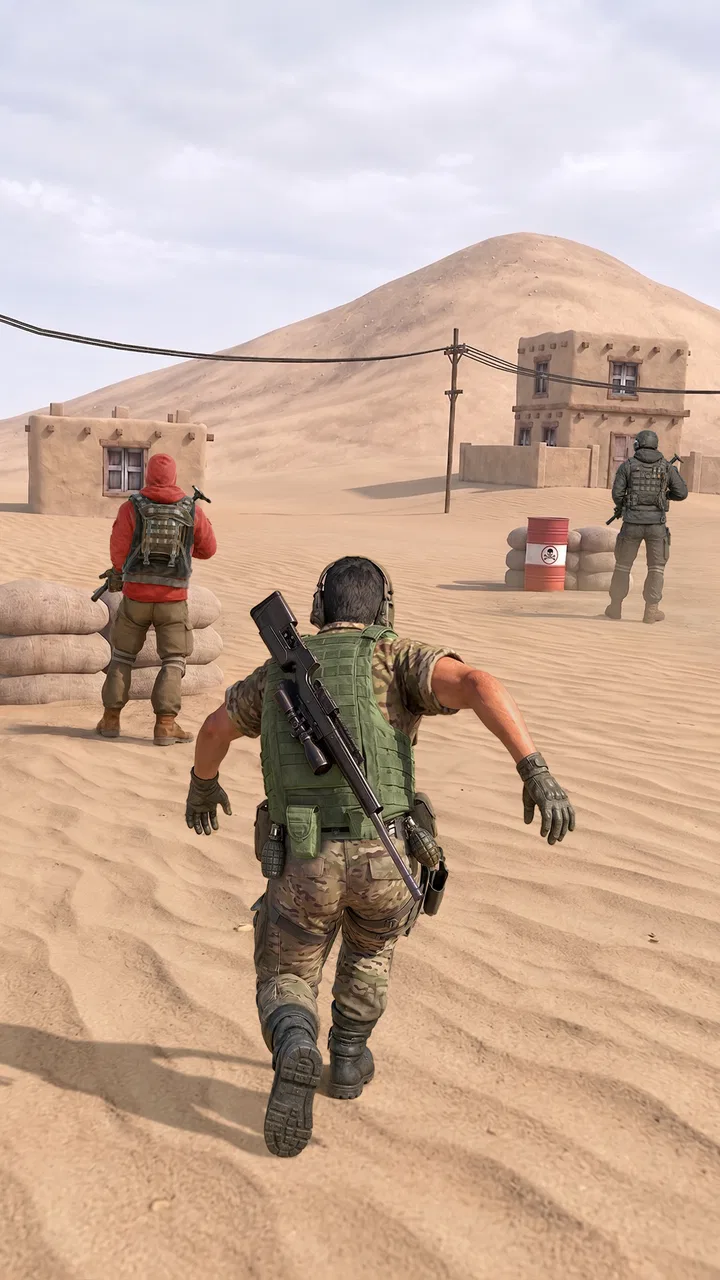
The visual direction supports that immediate reading. The military setting is presented in a straightforward way, using the expected language of combat zones, weapons, and mission targets rather than trying to turn the experience into a colorful arcade fantasy. That choice gives the game a recognizable tone. Even when the action is simple, I understand what kind of situation the game wants me to inhabit.
What I like is that the setting does not overwhelm the play. The environments function as spaces for movement and encounters, not as decorative backdrops that demand constant attention. This keeps the focus on the next objective and on reading the immediate danger. The trade-off is that players who want a richly layered world may find the locations more functional than memorable.
That balance also affects the pacing. The game is easier to enjoy when I treat each mission as a contained burst of action rather than expecting every stage to deliver a major narrative development. It creates a comfortable pick-up-and-play loop, but it also means the experience depends heavily on whether the shooting and mission flow remain satisfying over time.
A military world built through visual shorthand
Elite Commando: Gun Games does not need lengthy exposition to establish its world. Its art direction relies on familiar military signals: the soldier protagonist, combat-focused objectives, weapon handling, and spaces shaped around confrontation. This is not a criticism by itself. In a mobile action game, visual shorthand can be useful because it lets me understand the situation immediately.
The advantage is clarity. I know that the environment is there to be crossed, searched, or defended, and I can concentrate on the task instead of decoding an abstract setting. The disadvantage is that the atmosphere can feel familiar rather than distinctive. If you have played several military action games, you may recognize the visual vocabulary quickly and wish the locations had a stronger personality of their own.
I found the art direction most effective when it supported the pressure of a mission. A restrained combat environment makes the appearance of enemies and the approach to an objective feel more important. The game does not need to cover every surface with visual effects to create tension. In fact, a cleaner presentation helps me notice the practical information that matters during play.
One useful habit is to pause mentally before moving into a new area. Rather than rushing because the game has already established an action-heavy mood, I look at the available space and consider where danger is likely to come from. This makes the visual design more than decoration: it becomes a basic tool for deciding when to advance and when to be cautious.
Why the setting works better in short sessions
The military mood is convincing enough to support repeated short visits, but I do not think it is designed to carry a long, slow campaign by itself. The setting gives the missions context, while the gunplay provides the immediate reason to continue. That relationship works best when I play in focused bursts instead of expecting a large world to reveal new layers every few minutes.
This makes the game a reasonable choice for a commute, a break, or an evening when I want direct action without a major learning curve. A realistic everyday scenario would be opening it after finishing a few tasks, playing through a mission while still having enough attention to react to enemies, and stopping before the repetition becomes noticeable. The game fits that use better than a long-form role-playing adventure that requires remembering many story details.
On the other hand, if you prefer games where exploration, character relationships, and world-building are the main attractions, this may not satisfy you. Its setting is there to frame the action, not replace it. I would choose a story-heavy alternative when I want emotional investment or a more unusual fictional world.
Sound, rhythm, and the feeling of a mission
Sound is important in a game built around gun battles because it determines whether each encounter feels weighty or merely functional. Here, the audio direction works as part of the combat atmosphere. Weapon sounds and action cues help reinforce the sense that I am moving through a dangerous situation, while the overall presentation keeps attention on the mission rather than turning every moment into a dramatic spectacle.
I prefer this restrained approach to an audio mix that constantly tries to shout for attention. When sound supports the action instead of competing with it, I can focus on movement and timing. The result is a playable mood that feels more coherent: the visuals establish the military setting, the sound confirms the danger, and the mission structure gives both elements a reason to exist.
The rhythm is equally important. The game’s appeal depends on how it moves me from preparation into confrontation and then toward completion. I enjoy the moments when the pace gives me just enough time to orient myself before asking me to react. That small pause matters because it prevents every mission from becoming an indistinguishable stream of targets.
Still, the rhythm is not endlessly varied. A mission-based action game can begin to feel predictable when the same basic pattern is repeated too often. My advice is to pay attention to how you feel after several missions rather than judging the game only by its opening. If the act of approaching an objective, handling an encounter, and finishing the task remains enjoyable, the straightforward structure will work for you. If you need constant mechanical surprises, the repetition may become a problem.
Using the pace instead of fighting it
I found it more satisfying to play with the game’s rhythm than to force it into a frantic style. Rushing every encounter can make the action feel messy, especially when the environment is asking me to notice where I am before committing to the next movement. A better workflow is to use the quieter moments to reset my attention, then treat each engagement as its own small problem.
This is one of the less obvious strengths of the presentation. The game does not need a complicated tactical layer to reward basic discipline. Simply separating movement, observation, and shooting can make the missions feel more deliberate. That approach is particularly useful on a phone, where visual space is limited and impulsive movement can be harder to correct than on a larger screen.
Sound also helps me recognize the change between travel and danger. Even when the game is not giving me a detailed story, the audio atmosphere keeps the mission from feeling like a series of disconnected menus. That continuity is modest, but it matters when the main goal is to create a believable combat mood within a compact mobile format.
Where the mechanics fit the presentation
The central mechanical promise is clear: take control of a soldier, complete missions, and handle intense gun battles. I like that the game does not hide its main attraction. The action is easy to understand, and the mission structure gives me a reason to keep moving rather than wandering without purpose.
That clarity makes the game approachable for newcomers. Someone who has not played many mobile shooters can understand the basic loop quickly. I do not need to learn a large collection of character classes or build an elaborate loadout before finding out whether the combat is enjoyable. For a free game, that low barrier is valuable.
However, accessibility and depth are not the same thing. The experience is most appealing when I want direct action, not when I want a highly detailed simulation. Players who enjoy carefully balancing equipment, coordinating several teammates, or mastering a competitive ranking system may prefer a more specialized alternative. Elite Commando: Gun Games is better understood as an accessible action title with a military skin and mission focus.
One practical tip is to avoid judging the game solely by how quickly it lets me start shooting. The more useful question is whether the missions give that shooting enough structure. I look for objectives that make movement meaningful, encounters that reward awareness, and a pace that prevents the gunplay from becoming automatic. Those are the details that determine whether the game remains enjoyable after the novelty of the setting fades.
Free access and the cost of continuing
The game is free to download, which makes trying it straightforward. It also includes in-app purchases ranging from $0.99 to $8.99 per item. I would keep that in mind before settling into a long session, especially if the game presents optional purchases during the natural flow of missions. Free entry is helpful, but a comfortable experience depends on whether you are willing to ignore purchases and play within the basic progression.
My advice is to decide your boundary before playing. If you only want a few action missions now and then, the free structure may be enough. If you are the kind of player who feels pressure to buy upgrades whenever progress slows, it is better to treat the purchase options as a real part of the decision rather than an afterthought. That is not unique to mobile games, but it is especially relevant here because the straightforward combat loop can encourage repeated sessions.
The game is rated Teen, so it is aimed at an older audience rather than young children. Parents should consider that rating alongside the military setting and gun-focused action before allowing a child to play. For adult players and teens who are comfortable with this type of combat presentation, the rating is consistent with the game’s identity.
Who will enjoy it, and who should skip it
I would recommend it to players who want a soldier-themed action game that can be understood quickly, enjoyed in short bursts, and returned to without a long preparation phase. It is also a sensible option for someone who likes mission-based shooting but does not want to begin with an enormous download or a complicated competitive ecosystem.
I would be more cautious about recommending it to players who need a strong narrative, highly distinctive art direction, or deep tactical decision-making. If your favorite part of a military game is managing a squad, planning a multi-stage operation, or experimenting with complex builds, this may feel too direct. A dedicated strategy game would serve that audience better.
It is also not the right choice if you dislike repeated combat loops. The game’s mood and accessible structure can make the first sessions inviting, but the long-term value depends on your tolerance for returning to a familiar mission formula. I would download it when I want reliable action, not when I am searching for a constantly changing adventure.
My atmosphere verdict after living with the game
Elite Commando: Gun Games succeeds when its art, sound, setting, and pacing work together to make a simple mission feel purposeful. The military presentation gives the action a clear identity, the audio reinforces the sense of danger, and the mission rhythm makes the game easy to pick up. None of those elements needs to be excessively elaborate for the combination to work.
The main limitation is that the same clarity can become familiarity. The game does not appear to be chasing the complexity of a large tactical shooter, and that is both its advantage and its boundary. I enjoy it most when I want a focused action session with a soldier at the center, but I would choose another title for a deeper story, broader exploration, or more demanding strategic play.
Its audience size suggests that the format has found plenty of interest: it has passed ten million installs and holds a 4.4 average from around ninety-eight thousand ratings. I see those figures as evidence of broad appeal, not a guarantee that every shooter fan will love it. The game’s current version is 1.1.45, and it runs on Android 7.1 or later, which keeps it accessible to many older devices.
For me, the best way to approach the game is to set realistic expectations. It is a free action game from Bolt Bridge Games built around soldier missions and gunfights, not a replacement for every kind of military experience. If that focused promise matches what you want today, the low-cost entry makes it easy to try. If you need a world that surprises you constantly or mechanics that demand long-term study, I would look elsewhere.
My final view: this is a coherent, approachable mobile combat game whose strongest quality is the way it maintains a recognizable military mood without burying the player in complexity. I would keep it installed for short action sessions, especially when I want a clear objective and immediate tension. I would not rely on it as my only shooter, but as a free and accessible option, it earns a fair recommendation.
FAQs for Elite Commando: Gun Games
01What is the main objective of Elite Commando: Gun Games?
Elite Commando: Gun Games is a first-person shooter that immerses players in intense combat scenarios. The main objective is to complete various military missions, which can include rescuing hostages, eliminating enemy forces, or retrieving sensitive information. Success in these missions requires strategic thinking and precise shooting skills.
02Is Elite Commando: Gun Games free to play?
Yes, Elite Commando: Gun Games is free to download and play. However, it offers in-app purchases that allow players to enhance their gaming experience. These purchases can include new weapons, upgrades, and cosmetic items. While they are optional, some players may find them beneficial for advancing in the game.
03What are the system requirements for Elite Commando: Gun Games?
Elite Commando: Gun Games is designed to run smoothly on most modern Android and iOS devices. It typically requires a minimum of 2GB RAM and Android 5.0/iOS 10.0 or later. For the best experience, ensure your device is updated and has sufficient storage space, as updates and additional content may increase the app's size.
04Does Elite Commando: Gun Games offer multiplayer modes?
Yes, Elite Commando: Gun Games includes both single-player and multiplayer modes. In multiplayer mode, players can team up with friends or compete against others worldwide in various competitive scenarios. This mode adds an extra layer of excitement as you test your skills against real opponents.
05How often are updates released for Elite Commando: Gun Games?
The developers of Elite Commando: Gun Games regularly release updates to improve gameplay, fix bugs, and add new content. These updates often include new missions, weapons, and game modes, ensuring that players have a fresh experience and continued engagement. It’s recommended to keep your app updated for optimal performance.
Pros
- Immersive graphics enhance gameplay.
- Diverse weapon selection for strategy.
- Smooth controls and intuitive interface.
- Regular updates with new missions.
- Offline mode available for on-the-go play.
Cons
- In-app purchases can be pricey.
- Occasional ads interrupt gameplay.
- Requires significant storage space.
- Battery drains quickly on older devices.
- Limited multiplayer options available.

Elite Commando: Gun Games
Gallery